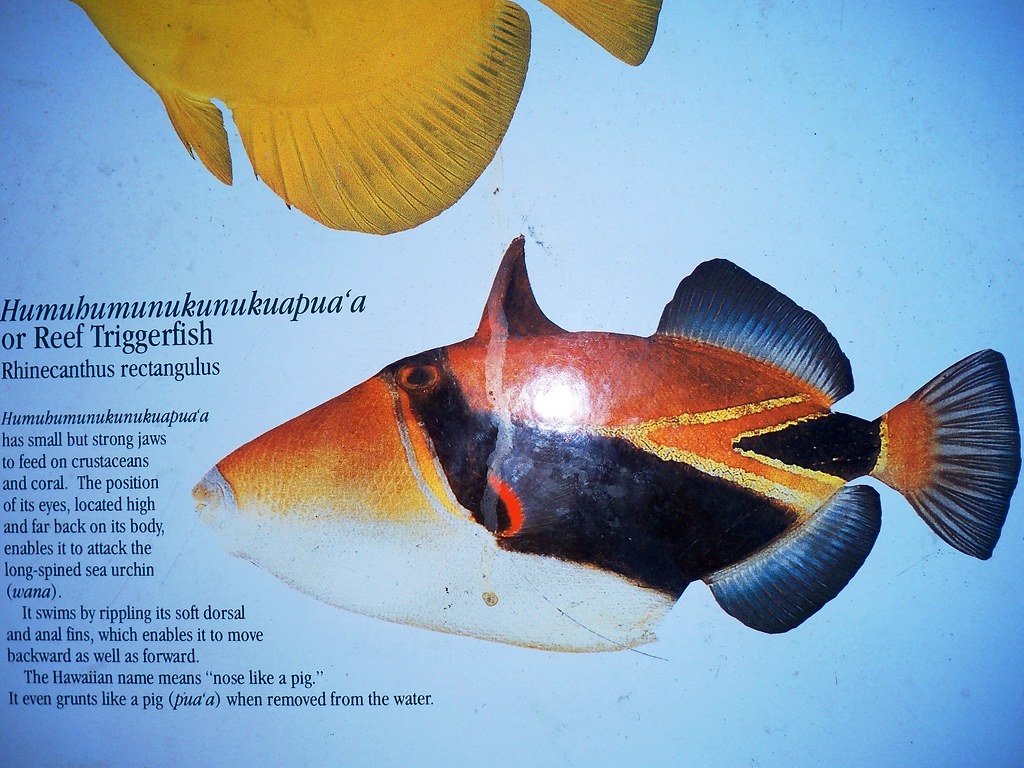
Traditional Hawaiian naming conventions rely on acute ecological observation. Native ocean navigators and fishermen did not catalog marine life through abstract Latin binomials. They classified species by their structural characteristics, habitats, and mythological associations.
The name humuhumunukunukuāpuaʻa breaks down into descriptive morphemes:
- Humuhumu: The general Hawaiian term for all triggerfish. The root verb humu means "to sew" or "to fasten pieces together." This references the way the fish's distinct dorsal spine locks into place, as well as the geometric, stitched-together appearance of its brightly colored scales.
- Nukunuku: A duplication of nuku, meaning "snout," "beak," or "pointed nose."
- Āpuaʻa: Derived from puaʻa (pig), combined with the prefix ā meaning "resembling" or "in the manner of."
Put the pieces together, and the formal taxonomy resolves into "triggerfish with a snout like a pig."
This connection extends into traditional Hawaiian religion. In oral history, the shape-shifting demigod Kamapuaʻa, a powerful deity capable of transforming between a fierce hog and a handsome man, fled the wrath of the volcano goddess Pele by diving into the sea. Upon entering the waves, he shifted form into the humuhumunukunukuāpuaʻa. The fish retains his dark markings, his unyielding temper, and his unmistakable porcine grunts to this day.

